
Multiplication games for kids
No sign-up · made for kids 4–10Multiplying starts with counting in equal groups and grows into quick times-table facts. These free games go in that order: hop a frog along the lily pads in 2s, 5s and 10s, see small sums as groups of dots, then blast number rocks with the times tables your child picks, from 2 to 12. Every game starts with the easy tables and grows as your child gets them right. They play in the browser with no sign-up, no ads and nothing to buy.


About each game
A line on every game here
›
- Times Tables Blaster Help the echidna astronaut blast the number rocks, from candy skies to the Moon!
- Skip Counting Hop Hoppy the frog along the lily pads by counting in 2s, then 5s, 10s and 3s.
- Maths Duel Race friendly Wombat up the sky!
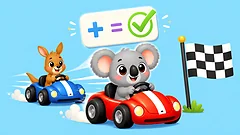
- Math Race Race your koala kart from the outback to candy land!
About these games
Our picks and what they practise
›
Times Tables Blaster lets your child choose which tables to practise, from 2 to 12. The easy ones come first (2, 5 and 10, then 3, 4 and 11, then 6 and 9, then 7, 8 and 12), and each stage starts with × 1 to × 3 before going up to × 12. Skip Counting builds the counting-in-steps that times tables grow from.
Maths Duel shows small times sums as groups of dots, so children can count them before they remember the answer, and Math Race mixes in times tables starting with × 1, × 2, × 5 and × 10. Speed comes last: a wrong answer just means another try.
Our picks



What they practise
- What multiplying means: equal groups
- Skip counting in 2s, 5s, 10s and 3s
- Times tables from 2 to 12, easiest first
- Quick recall of multiplication facts
Next
Questions parents ask
4 quick answers
›
What are good free multiplication games for kids?
Times Tables Blaster, Skip Counting, Maths Duel and Math Race on Tiny Players are free multiplication games for 2nd to 5th grade. They start with the easy tables (2, 5 and 10) and grow to 12, and play in the browser with no sign-up, no ads and nothing to buy.
Which times tables should kids learn first?
Most children find 2, 5 and 10 easiest, then 3, 4 and 11, then 6 and 9, with 7, 8 and 12 last. Times Tables Blaster brings them in in that order, and your child can pick which tables to practise.
How do kids get faster at times tables?
Little and often. Counting in steps and seeing equal groups comes first; quick recall grows from lots of short, happy practice. These games reward right answers and never punish a wrong one.
Can two children play together?
Yes. In Maths Duel two children can race on one screen, each with their own answer keys.